Welcome to the Naples Jazz Lovers Website.
The jazz musicians and fans of S.W. Florida celebrate mainstream jazz and the Great American Songbook performing at venues in the greater Naples Area. We are grateful for the outstanding support that has sustained our performances and continue to build the jazz enthusiast community that we've come to know as The Naples Jazz Lovers!
Please email me, Bob Zottola for our weekly newsletter and event notifications at the following email address:



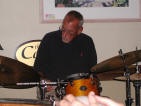

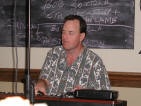

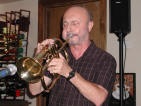


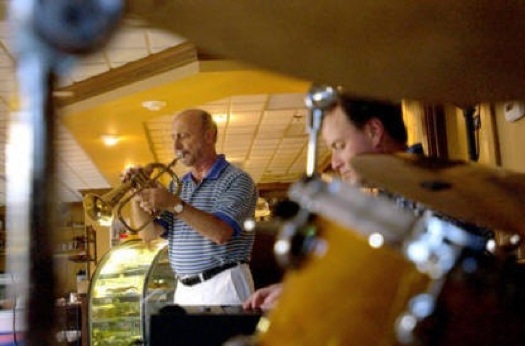

Only the Shadow Knows
Who will Show up & Play
(article from the Naples Daily News 8/10/06)
My Life So Far
'Trying to play each note as best you can' Bob Zottola, musician
Thursday, August 10, 2006
Bob Zottola stands, tapping his feet. He snaps his fingers.
One-two-three-four, one-two-three-four
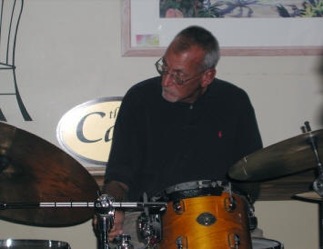
The drums and piano kick in.
Tap-tap-tap-tap
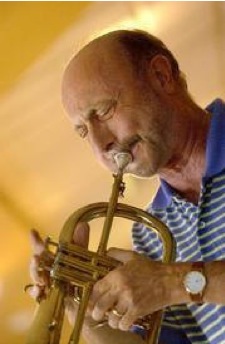
And then he starts to play. The melody to the Rodgers and Hart classic "Have You Met Miss Jones?" blasts from Zottola's trumpet.
Ba-ba-dada-da
Then he busts into his solo. He bends his knees and arches his back. His eyes close tightly. His cheeks puff out.
Zottola works thoughtfully through a series of chord progressions and runs, each note effortlessly following the next. After a few moments, it's over. He relaxes, rests his trumpet behind his back and watches guitar player Rick Howard take his turn.
Howard exchanges a knowing glance with the trumpeter, acknowledging Zottola's solo and saying, "Check out what I can do with that."
This sort of interplay among musicians has been part of Zottola's life for most of his 69 years. Sometimes he's in the spotlight, but more often he's been a complementary player to a bigger name. Frank Sinatra, Benny Goodman, Rosemary Clooney, Chick Corea. To name a few.
Zottola had a lot to say about the music business, about Broadway, being on the road and about that dreaded "R" word — retirement. Here are the high notes, in his own words:
The early days
I come from a musical family. I've always had music in my life.
My parents were musicians. My father played the trumpet and the violin. He played all over the tri-state area — New York, New Jersey and Connecticut, where I grew up.
There was always a band practicing in my house.
I went to school and the band director came up to me. "I hear your dad is a professional musician. You want to join the band?"
I went home to tell my father and he pointed to the trumpet on top of the piano.
My father gave me lessons. And after high school I studied with some of the best players in the New York area.
His education
I joined the Air Force and the continuation of the Glenn Miller Band, the group that played in "The Glenn Miller Story" with Jimmy Stewart. That was before I joined, so I wasn't a part of that.
But it was a great experience for me. I got to play with a bunch of real pros. There were some great players, like Tommy Newsome who played on "The Tonight Show" with Doc Severinsen. Just tremendous musicians in that band.
All of those guys were 10 or 15 years older than me. They showed me the way. That was my college education in music.
His first tour
The first tour I went on was with Charlie Barnett. It was less than fantastic.
I had a vision of what I thought playing with a big band on the road would be like. But this was already at the tail end of the Big Band era.
You were riding in the car with Charlie Barnett, drinking and smoking. And you were wondering what exactly it was that they were smoking, and if that person should really be driving.
I guess there's a certain charm to all that. But that wasn't what I was hoping for exactly.
The Chairman of the Board
Frank Sinatra is without a doubt the best singer I ever worked with. If you ask Tony Bennett who's the better singer, I'm certain he'd say Frank, too.
Part of it is the charisma, both positive or negative with the mob ties and all that. He kind of played that up and it allowed him to be even more successful.
But aside from all of that, the man was an exceptional musical talent. He transformed the whole vocal world and beyond.
You can talk to the great instrumentalists, they'll talk about how he influenced them. Miles Davis used to talk about Frank as an influence.
He was just incomparable in interpreting the song. He could make you feel every emotion.
Doing his part
As a musician in the band, your intent has to be to enhance the performer, to give a foundation for that person to succeed on.
It's little spurts here and there, trying to play each note as best you can. Maybe you get a solo here and there and try to stand out. But it's all about the performer.
When I played with Chick Corea it was a little different because you were so amplified. Every player had his own giant speaker right above him. When you played it was like you were Gigantor or the Hulk. When I played my trumpet then, it was like 50 trumpets.
It was almost disconcerting.
On Broadway
I had a full-time gig playing in "Les Miserables" for 16 years, until it closed in 2003.
I was using Broadway as my steady job. Musicians don't typically have steady jobs. To most a steady job is three weeks or a month.
But being gainfully employed let me do things like go out on the road with Chick Corea or Frank Sinatra and still pay the mortgage.
There are only about 400 full-time musicians on Broadway, maybe not even that many anymore. "Les Miz" pulled the plug in part because of September 11. Broadway, especially the musicals, are so dependent on tourism.
The great thing about working on Broadway is that you are responsible for your part. If I wanted to go out on tour or needed a break, all I had to do was find someone to take my place for those shows.
And you need a break, doing eight shows a week is a grind. You play the same thing every night. But it's almost like practice. Each night you come in and think about how you can make your performance just a little better. How you can play the notes better.
On retirement
Retire is a very dirty word to me. I don't like to think of myself as retired. Maybe I'm slowing down a little bit, but I still play gigs, both here and up north.
I never really planned it like this. My wife and I came down here to Naples in 1986 or 1987 because my sister-in-law used to come here. We loved the place and started coming down more often. We bought our house in 2000.
But it wasn't really until the "Les Miz" closing that I started thinking, "Is now the time to retire? Do I really want to lock in to a new Broadway show?"
I realized I didn't have to worry about making the mortgage payment anymore and I could just play what I wanted to play.
That's how I got started down here. They don't pay me enough for me not to play the music I want to play. And I get to play it in front of people who really love the music and understand it.
One night in Barcelona
When I was a kid, live music was a big deal. There wasn't much radio to speak of and you had to scrape up you pennies to buy a 78 (rpm record). So the best place to hear music was live. If someone said there's live music, we went to it.
Now we live in the iPod age. Music isn't as hard to come by. So people don't need the live performances as much ...
When I went on a world tour with Chick Corea we were well-received everywhere except for one stop. Barcelona.
Chick had this great love of Latin and Spanish music. We started playing this song, this very flamenco-ish song. Everywhere people loved it. Except in Spain.
We were in this huge amphitheater with thousands of people and we were playing this song. All of a sudden I started noticing the people were throwing pebbles onto the stage. Pretty soon it wasn't pebbles anymore, but rocks.
I thought, "This is weird." I couldn't understand why they were throwing rocks at us. We didn't find out until later that flamenco meant something politically to these people, and some of the audience there weren't on that side of the politics.
It would be like going to Lebanon now and waving an American flag.